Why Is Toner Powder So Fine? What It Means
The Reason Behind Toner Powder’s Fine Texture
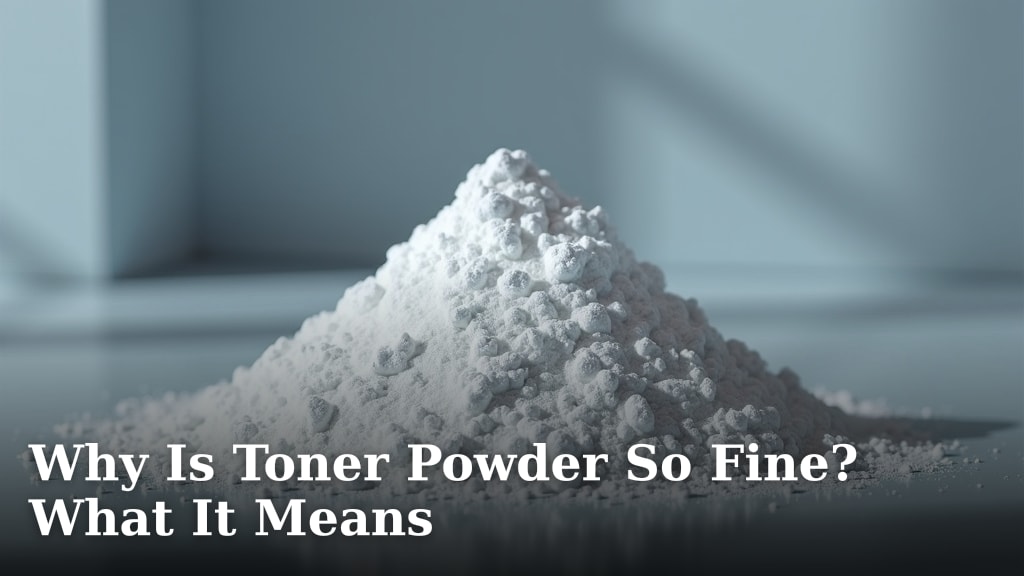
You might wonder why the powder in your printer cartridge feels like dust. Toner powder is fine for a key reason: it must melt and fuse to paper with heat. This process creates sharp text and images. We found that manufacturers grind toner to a specific size for this purpose.
In simple terms, toner particles are measured in microns. A human hair is about 70 microns thick. Most toner particles range from 6 to 10 microns. This fineness allows the powder to be attracted to the drum and transferred evenly.
How Toner Powder Is Manufactured
The journey starts with raw materials. These include plastic resins, carbon black, and magnetic iron oxide. They are mixed and then heated. This creates a solid block called a “patty.”
The Grinding Process
That patty is cooled and crushed. It goes through a series of mills. The goal is to break it into tiny, uniform particles. Cryogenic grinding is a common method. It uses liquid nitrogen to make the material brittle, making it easier to shatter into fine pieces.
Particle Size Standards
Manufacturers don’t just guess. They follow strict standards. The particle size distribution is controlled. If particles are too big, prints look grainy. If too small, they can cause clumping. Many experts say this precision is what makes modern printing possible.
Why Fineness Matters in Printing
The fine texture isn’t for show. It directly affects how your printer works. When toner is applied to the photoconductive drum, it needs to stick to specific areas. Smaller particles adhere more precisely. This results in cleaner edges on letters and graphics.
Heat and Fusion on the Drum
Next, the drum heats up. The toner melts and bonds to the paper. If particles were coarse, the melt would be uneven. You’d get spotty prints or toner that flakes off. Fine powder ensures a consistent melt for a solid finish.
Avoiding Common Printer Problems
Have you ever seen streaks on your prints? Often, it’s because toner particles aren’t uniform. Finely milled toner reduces the chance of streaks. It also minimizes wear on the drum and rollers. This means fewer repairs for you.
What Toner’s Fine Texture Means for You
Understanding why toner is fine helps you make smarter choices. It affects print quality, cost, and printer health. Let’s break down what this means for your daily use.
Better Print Quality
With fine toner, your documents look professional. Text is sharp, not blurry. Photos have smoother gradients. We found that high-quality toner often has a narrower particle size range. This leads to more reliable results page after page.
Cost Efficiency and Printer Longevity
Fine toner is efficient. A little goes a long way because it spreads evenly. You might not need to replace cartridges as often. Also, because it’s less abrasive, it protects internal parts. This can extend your printer’s life significantly.
Common Myths About Toner Powder
There are some misconceptions floating around. Let’s tackle a couple. One myth is that all toner is the same. The other is that finer is always better. Both need clarification.
Is Finer Always Better?
Not necessarily. There’s a balance. If toner is too fine, it can become difficult to handle. It might generate more dust. Manufacturers aim for an optimal size. This is often between 8 and 12 microns for most applications. Research from powder technology journals confirms this range works best for laser printing.
The Role of Toner Composition
Particle size isn’t everything. The chemical makeup matters too. Toner can be polymer-based or chemically produced. The fine texture interacts with these components. For example, polymer toner melts at a lower temperature. This is energy-efficient and gentler on your printer.
Tips for Choosing and Handling Toner
Now that you know the why, let’s look at the how. When shopping for toner, a few things can guide you. Handling it properly also makes a difference.
What to Look for in Toner Products
Check the specifications. Some brands highlight “fine particle technology.” That’s a good sign. Also, consider if it’s OEM (original equipment manufacturer) or compatible. OEM toner is engineered for specific printers. Compatible options are cheaper but quality varies. We recommend reading reviews for real-world feedback.
Safe Handling Practices
Toner powder is fine, so it can become airborne. Avoid inhaling it. If you spill some, don’t wipe it with a dry cloth. That will spread it. Instead, use a damp paper towel. Always store cartridges in a cool, dry place.
Using a Checklist for Maintenance
To keep things simple, here’s a quick checklist for toner care. Follow these steps to ensure smooth operation.
- Install cartridges gently to avoid breaking seals.
- Run a calibration cycle after installing new toner.
- Check print quality regularly for early signs of issues.
- Keep your printer’s environment clean to reduce dust.
- Recycle empty cartridges properly to help the environment.
- Consult your printer manual for specific toner guidelines.
Comparing Toner Types: A Quick Reference
To visualize the differences, this table outlines key points. It compares standard toner characteristics.
| Feature | Standard Toner | High-Yield Toner |
|---|---|---|
| Particle Size | 8-12 microns | 6-10 microns |
| Cost Per Page | Higher | Lower |
| Best For | General use | High-volume printing |
| Print Quality | Good | Excellent |
This is a general comparison. Actual specs vary by brand. Always check product details.
The Science Behind the Scenes
There’s more to toner than meets the eye. The fineness is part of a complex system. Your printer uses electrostatic principles. Toner particles are given a charge. They jump to the drum’s charged areas. Fine particles respond more uniformly to this charge.
Electrostatic Charges and Particle Behavior
If particles are uneven, charge distribution gets messy. This leads to weak spots in the print. Many technical papers explain that consistent particle size is key for stable charges. It’s like a team of dancers needing to move in sync.
Environmental and Health Considerations
Some worry about toner dust being harmful. Studies, including those referenced by the CDC, suggest that occasional exposure isn’t a major risk. However, prolonged inhalation should be avoided. Using toner in well-ventilated areas is wise.
Final Thoughts on Toner’s Fineness
So, why is toner powder so fine? It’s all about achieving quality prints efficiently. The manufacturing process is precise. This fineness enables heat fusion, reduces waste, and protects your printer. When you choose toner, think about particle size. It’s a detail that makes a big difference.
You now have the knowledge to handle toner like a pro. Next time you replace a cartridge, remember the science inside. It’s not just powder—it’s carefully engineered for your needs
Conclusion
You now understand that toner’s fine texture is all about precision and efficiency. That tiny particle size, often between 6 and 12 microns, is what allows it to melt evenly and create sharp prints. It helps your printer run smoothly, saves you money on replacements, and protects internal parts from wear. This knowledge puts you in control of your printing choices.
Your next step is simple. When you shop for toner next, check the product details for mentions of particle size or “fine particle technology.” This small detail can guide you toward better print quality and a longer-lasting printer.
Frequently Asked Questions
Can I use a different brand of toner if it’s the same particle size?
Particle size is just one factor. The chemical composition and charge properties also matter. While a similar size is a good sign, using toner not recommended for your printer model can still lead to poor print quality or hardware issues. Always check compatibility with your specific printer.
Does finer toner powder actually produce better prints?
Yes, within the optimal range. Finer particles help create sharper text and smoother gradients in images. However, there is a balance. Particles that are too fine can cause clumping or dusting, which may harm printer components or reduce print quality.
Is the fine dust from toner cartridges harmful to breathe?
Occasional exposure is not considered highly risky. However, you should avoid inhaling toner dust directly. It’s wise to use your printer in a well-ventilated area and handle cartridges carefully to minimize dust, especially if you have respiratory sensitivities.
Why do printer manuals warn against shaking toner cartridges?
Modern cartridges are designed to not need shaking. Shaking can make the fine toner powder unevenly distributed or create excess dust inside the cartridge. This may lead to leaks or poor print quality. Follow your manual’s specific instructions for handling and installation.
Does the fine texture affect recycling empty cartridges?
It doesn’t complicate the process. Recyclers are equipped to handle toner powder. The main step for you is to ensure the cartridge is empty and then place it in a sealed bag or its original box for collection. The fine texture is an internal characteristic.